My daughter showed me Flo before I’d really heard of it. A friend had it, so she downloaded it, and one evening she turned her phone toward me and asked if it was okay to use. I did what most parents do at that point. I typed is Flo safe for teens into a search bar and started reading.
What I found was more complicated than a yes or no. Flo is a careful, well-made app with millions of users, and it has also been at the center of one of the larger privacy stories in this category. If you’re asking the same question I was, here is what I learned, laid out the way I’d want a friend to lay it out for me.
One thing up front, so you can weigh what I say: I co-made a period tracker for teens with my teen daughter called TeenCycle, so I’m not a neutral party here. I’ll come back to it near the end and tell you plainly where it gives you less than Flo does. The rest of this is about how to judge any period app.
First, the honest part: Flo is a good app.
I want to be fair before I get into the privacy history, because fairness is the whole point. Flo is polished. The predictions are thoughtful, the cycle education is genuinely useful, and in 2022 the company added an Anonymous Mode that lets you use the app without attaching your name or email. That was a real improvement, and I don’t want to wave it away.
Flo also sets a minimum age of 13 (16 in the EU), and it says plainly that it has never sold user data. For a lot of adults, Flo is a reasonable choice.
The question I had wasn’t really “is Flo a good app.” It was “is this the right place for my teenager’s most private information to live.” Those are different questions.
The privacy history a parent should know.
Here are the facts, with sources, so you can read them yourself rather than take my word for it.
In 2021, the U.S. Federal Trade Commission settled with Flo over allegations that the app had shared sensitive health information with outside companies, including large advertising and analytics firms, in a way that didn’t match its own privacy policy. As part of that settlement, Flo agreed to get clear user consent before sharing that kind of data, to undergo an independent review, and to notify the people whose information had been shared. You can read the FTC’s own summary of the case here.
That history is still working its way through the courts. In 2026, a proposed settlement of around $59.5 million involving Flo and two other companies received preliminary approval from a federal judge, covering data-sharing that was alleged to have happened between late 2016 and early 2019. A separate company involved in the same litigation declined to settle and was found liable by a jury in 2025. These are reported figures from ongoing proceedings, so the details may shift before everything is final.
I’m not telling you this to frighten you, and I’m careful not to. Flo has changed a lot since 2019, and the company has invested heavily in privacy features since. But the episode taught me something that has nothing to do with Flo specifically: with most period apps, your daughter’s information sits on a company’s servers, and you are trusting that company’s policies, its security, and its future decisions to keep it private. A policy is a promise. Promises can change, and they can be broken.
What “safe” actually means for a period app.
When a parent asks whether a period app is safe, I think they’re really asking four smaller things. It’s worth separating them.
Where does the data live. On the phone only, or on a company’s servers. This is the one that matters most, because it decides who could ever see the information, regardless of policy.
What the app asks for. Some trackers ask about sexual activity to power fertility predictions. For a 13-year-old, those questions can feel invasive, and the answers become data too. We wrote a whole separate piece on period tracker apps that don’t ask sex questions if that’s a sticking point for you.
Who can reach your kid. Feeds, messages, comments, and friend lists are where strangers get in. A tracker doesn’t need any of them.
What it costs, and how. Free apps usually earn money somewhere. That isn’t automatically sinister, but it’s worth knowing whether the business model depends on data or attention.
You can answer all four for any app by reading its privacy policy and its sign-up flow. It takes about ten minutes, and it’s the most useful ten minutes you’ll spend on this.
Flo and TeenCycle, side by side.
I co-made a period tracker, so I’m not a neutral party, and I’d rather tell you that than pretend otherwise. Here’s an honest comparison on the things a parent actually checks. Where Flo has more than one mode, I’ve noted it.
| What a parent checks | Flo | TeenCycle |
|---|---|---|
| Account required | Optional account; Anonymous Mode available | None, ever |
| Where data lives | Company servers (encrypted), syncs to cloud | On the phone only; nothing leaves it |
| Asks about sexual activity | Yes, for fertility features | No |
| Third-party sharing | None declared today; 2021 FTC case over past sharing | None |
| Social features (feed, messages) | Community features within the app | None |
| Price model | Free, with a paid subscription tier | Free for 7 days, then $9.99 once |
| Made for | General audience, all ages 13+ | Teenagers, specifically |
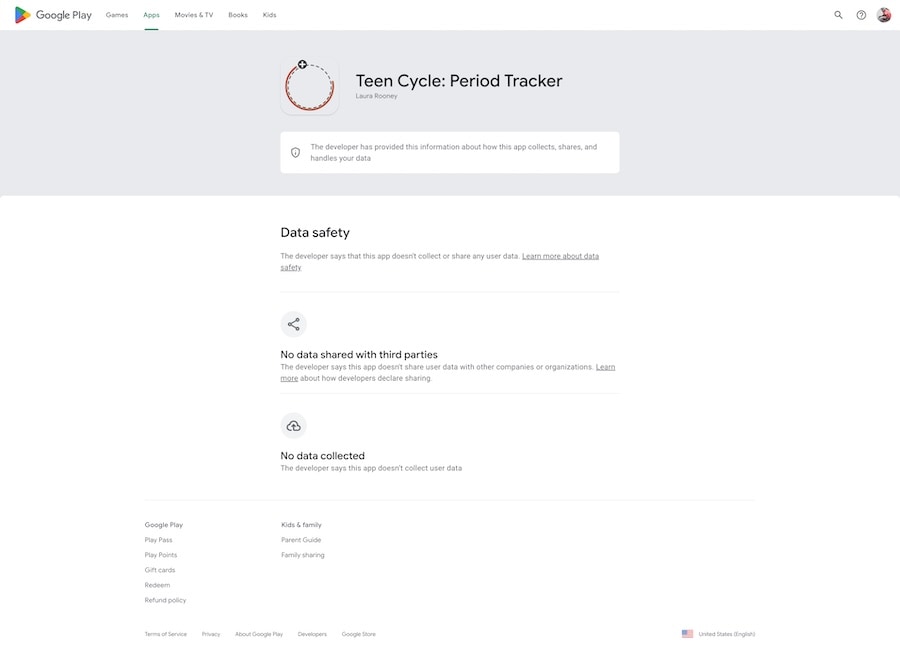
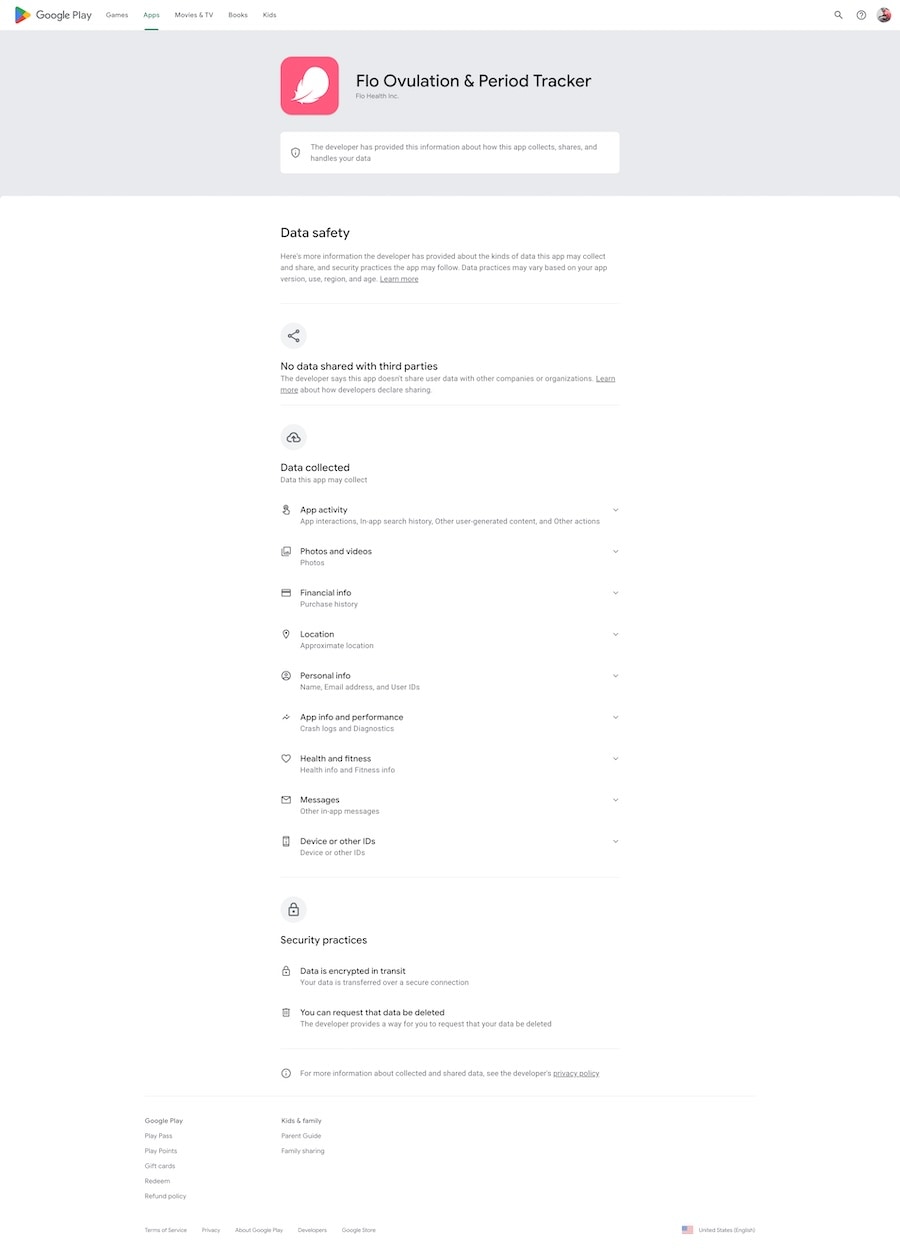
The differences come down to one design decision. Flo, like most trackers, keeps your data so it can do more with it. TeenCycle is built so the data never leaves the phone at all.
That distinction matters more than it first looks. Once a company holds your daughter’s information, you are trusting a few things to stay true for years: that its privacy policy won’t change, that it won’t use what it knows about her to market to her, and that it will never be breached. Those are reasonable things to hope for. They are not things anyone can promise. Policies get rewritten. “We don’t share your data” is not the same as “we don’t use your data.” And data leaks happen to large, careful, well-funded companies, not only careless ones.
None of that is a prediction about Flo in particular. It is true of any app that stores your information somewhere you can’t see. The only way to take the risk off the table is to not gather the data in the first place. That is the whole point of keeping everything on the phone: there is no server to breach, no policy that can quietly change, and no copy of your daughter’s cycle sitting on a company’s hard drive, waiting to be useful to someone later.
Neither approach is “wrong.” They answer different questions. If you want the richest feature set, the cloud model gives you more. If your first concern is that your daughter’s information simply has nowhere to leak to, the offline model is the stronger answer.
What we did about it.
When my daughter asked for a tracker, my husband, who builds software, and I looked at what existed and kept landing on the same worry. So we chose not to add the things that worried us. No account. No cloud. No analytics. No questions a teenager shouldn’t have to answer to log a period.
The result is that there is nothing on our end to leak, sell, or hand over, because there is nothing on our end at all. The only copy of the data is the one on the phone in her pocket. That’s not a privacy setting we ask you to trust. It’s the architecture. You can read exactly what “offline” means in our terms, because we wrote it in plain language.
I should be clear about one thing: no tracker, ours included, is a medical device, and predictions are estimates that get better with more logged days. If a cycle feels off, that’s a conversation for a doctor, not an app.
So, is Flo safe for your teenager?
My honest answer is that Flo is a capable app that has earned real scrutiny, and the right choice depends on which kind of safety you care about most. If you want a full-featured tracker and you’re comfortable with data living on a company’s servers, Flo with Anonymous Mode is a defensible pick. If what keeps you up is the data itself, where it goes and who might see it, then an app that keeps everything on the phone answers that worry more completely.
Read the privacy policy of whatever she ends up using. That’s the real takeaway, and it’s true no matter which app you choose. If you’d like one short, calm piece a month on this kind of thing, you can get the journal in your inbox — no tracking pixels, unsubscribe in one click.
TeenCycle is free for 7 days, then a one-time $9.99. No subscription. Download it on the App Store or Google Play and decide for yourself.
References & sources.
- Federal Trade Commission, Flo Health, Inc. case page — ftc.gov
- 2026 proposed class-action settlement (~$59.5M) and 2025 jury verdict: reported in ongoing court proceedings; figures preliminary and subject to change before final approval (final fairness hearing scheduled for October 2026).